

A total of 27 works from Zhangjiagang were showcased at the 2026 Suzhou Folk Arts and Crafts Exhibition, held in Fenghuang town, with more than 80 percent of them created by young artisans.
The growing presence of young creators reflects a broader shift in the city's traditional folk arts and crafts community. According to the membership records of the Zhangjiagang Folk Literature and Art Association, the organization has 135 registered members, nearly 60 of whom belong to its young artisans committee, made up of people born in the 1980s and later. They account for 45 percent of the total membership.
Handcrafting has long been part of life in Zhangjiagang. What is changing is the generation behind the work: more young people are taking up traditional crafts and transforming handmade techniques into works of art. Unlike older generations, who often learned their skills as a means of livelihood, many young artisans today combine formal arts education with a strong sense of aesthetics. For them, preserving tradition and pursuing innovation are not opposing goals but complementary parts of passing on their craft.
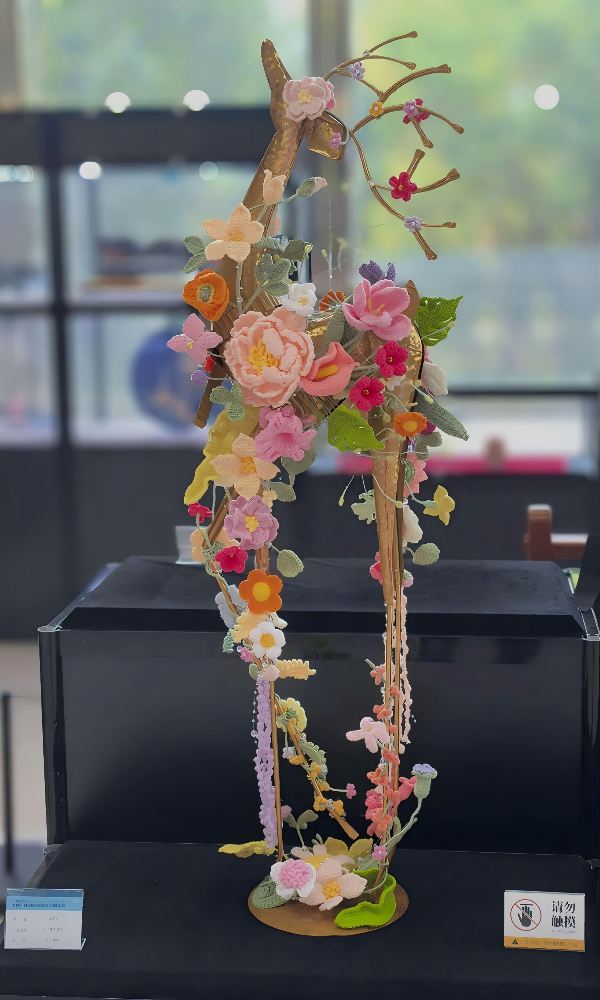
A Journey in Bloom, crafted by Zhangjiagang artist Zhou Jiayi. [Photo/zjgonline.com.cn]
Zhou Jiayi's work A Journey in Bloom offers a striking example. Standing 1.1 meters tall, the piece draws on Shazhou lace, a traditional craft native to Zhangjiagang. Traditionally, the lace is made by crocheting white thread into intricate tablecloths, curtains and coasters. Zhou reimagined the technique by using a metal deer as a floral vessel and attaching crocheted flowers in layers, creating a work that conveys the auspicious message of flowers blooming along the way. The contrast between hard metal and soft yarn gives the deer a lively appearance, while an age-old lace-making technique takes on a contemporary artistic form.
Beyond their creative work, young artisans are also becoming active promoters of cultural heritage. Lu Ling's studio, for example, has developed into a training hub for pottery teachers, regularly providing ceramic-making instruction for teachers and students at five schools in Zhangjiagang and four in Nantong.
Their growth has also been supported by an environment that creates opportunities for traditional crafts to reach wider audiences. Zhangjiagang has provided platforms through exhibitions, markets and outreach programs in schools and communities, helping individual artisans turn their creative pursuits into collective endeavors. Visits to exhibitions in Suzhou have also broadened their artistic horizons and inspired new forms of expression.
Traditional crafts are increasingly becoming a part of everyday community life. Pottery and crochet have emerged as popular courses in schools, attracting enthusiastic participation from students, while intangible cultural heritage handicrafts are among the most popular attractions at community temple fairs and markets. At discussion sessions, artisans who previously had little contact with one another exchange ideas and explore possibilities for collaboration, often inspiring new works through the interaction of different techniques.
With support from the government, participation from schools and growing public interest, Zhangjiagang is fostering an environment in which traditional folk arts and crafts can be passed down, reinterpreted and given new life by younger generations.
iSuzhou Service Platform for Foreigners in Suzhou
Technical support: Suzhou Daily Group iSuzhou Studio
Contact us: isuzhoustudio@163.com